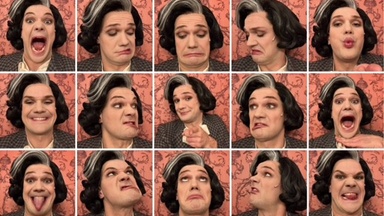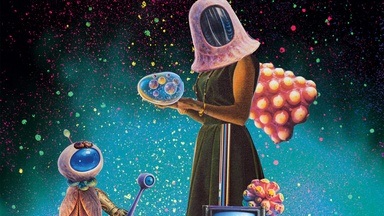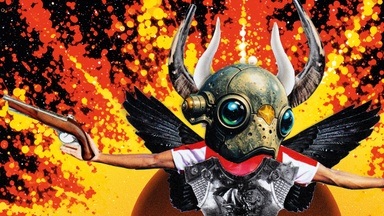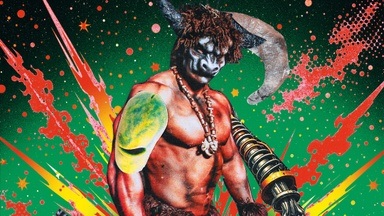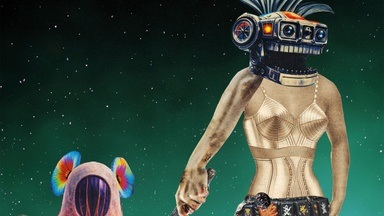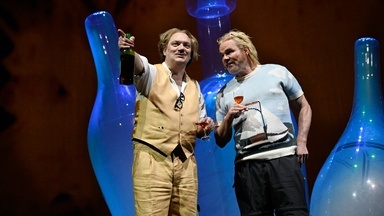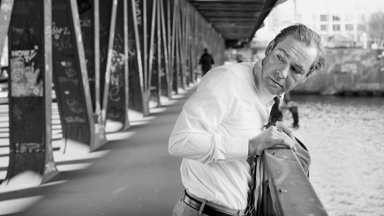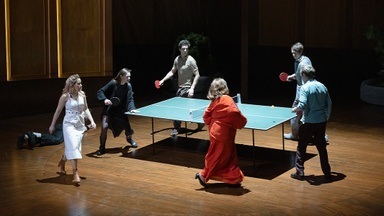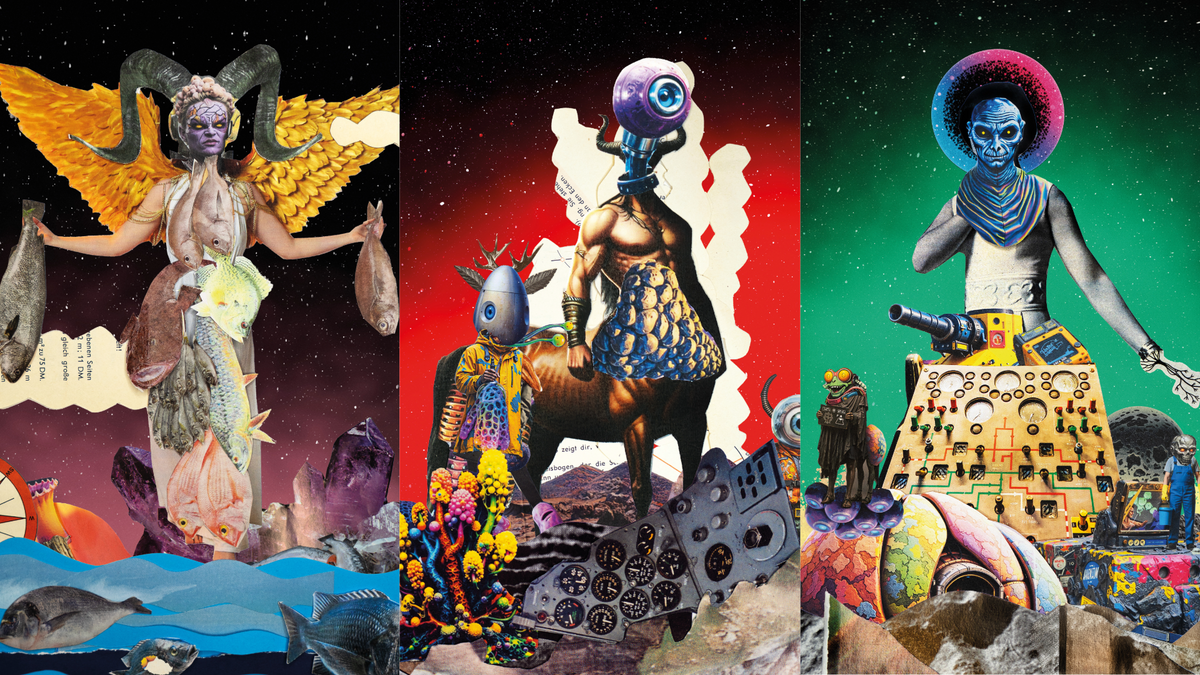
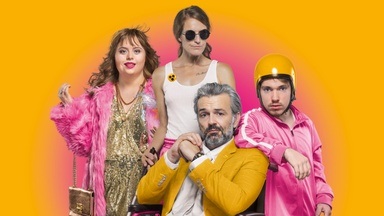
PHOTO: © Rocket&Wink
Prolog / Zwischenspiel / Die Argonauten
Hamburg

In the organizer's words:
STRANGE SUN
The Argonauts. Jason. Medea.
A six-part series by Roland Schimmelpfennig
Episodes I–III
Directed by Karin Beier
i. Prologue: The Golden Ram
Every myth has at least one prequel. And another. And yet another. With this prologue, Roland Schimmelpfennig returns to the very first one and tells the story of the origin of the Golden Ram. The violent transformation of the stargazer Theophane into a sheep by the sea god Poseidon gives rise to a hybrid creature—part animal, part god, part human—whose fleece has gone down in mythical history as the “Golden Fleece.”
A leap into another story, another time, and another place. There, King Athamas falls in love with Ino, daughter of Cadmus (!) of Thebes, and betrays his divine cloud-wife Nephele with her. She vanishes into the heavens. Her two children, Phrixos and Helle, now become easy scapegoats for a society that has succumbed to conspiracy theories and a scapegoat mentality. At Nephele’s behest, the Golden Ram appears to rescue the children. While Phrixos reaches Colchis on the flying ram, his sister Helle plunges into the sea. Since then, the spot has been called the Helles Pontus. The once-thriving city of Iolkos has grown into a cold, industrialized port metropolis. The sun must return—on that, the city’s residents are in agreement. Just at the right moment, the prodigal son and rightful heir to the throne, Iason, stumbles into the city. He is destined to be the one to save Iolkos from its decline.
ii. Interlude: Centaur, Cave, Tree, and Beam
Where does he even come from, this supposed savior and redeemer of humanity? In this interlude, we look back at Iason’s childhood and the cave of Chiron, a centaur to whom the little boy had been entrusted for protection after his regent father was murdered. The centaur—a demigod, half-horse, half-man with a drinking problem—dresses Jason in girls’ clothes as a disguise and torments him with harsh discipline. To him, Jason is the epitome of the “Self” generation—self-centered, self-absorbed, and self-righteous—and despite his mediocrity, Jason plants the seed of the Golden Fleece in his mind. Chiron’s main enemy is Plato, the seeker of truth, precisely because the centaur serves as a living example of Plato’s famous Allegory of the Cave.
In the end, Iason and Heracles—who is employed as a janitor—free themselves from the clutches of the centaur Cheiron and arrive in Iolkos together with a winged boy. Which is the better principle for survival: freedom, setting out into the unknown, and encountering the unfamiliar, or the safety of the cave of illusion?
iii. The Argonauts: Mission, Departure, and Odyssee
With a crew of more than dubious character, Jason finally sets out for Colchis to bring the Golden Fleece back to Iolkos. Should he succeed, the throne would be his for certain—so goes the insidious promise of his uncle and current regent, Pelias. The crew setting sail consists of Orpheus (the singer in the tunnel), Tiphys (the blind helmsman), Amphion (the devout cook), Akastos (the fingerless son), and a questionable “leadership team” consisting of Jason, Heracles, and the boy with wings. This bizarre crew is supported by a large number of energetic rowers. And then there may also be a stowaway on board: Atalanta, the invisible woman.
Roland Schimmelpfennig transforms the heroic epic into an anti-heroic grotesque of black humor with elements of splatter and mystery. The Argonauts’ paranoia gives rise to an increasing propensity for violence the closer they get to the stranger. The expedition is exposed as an imperialist plundering expedition caught between delusion and reality. An odyssey serving as a parable for the brutalization of human society under extreme conditions.
Prologue: Lina Beckmann, Sandra Gerling, Markus John, Jan-Peter Kampwirth, Bjarne Mädel, Maximilian David Scheidt, Devid Striesow, Kristof Van Boven, Michael Wittenborn, as well as Zofia Jablonska, Alanna Reimpell Bravo, and Ellen Burgess
Interlude: Markus John, Mirco Kreibich, Devid Striesow, Kristof Van Boven, as well as Joschua Enderlein and Felix Heßler
The Argonauts: Markus John, Jan-Peter Kampwirth, Mirco Kreibich, Bjarne Mädel, Maximilian David Scheidt, Devid Striesow, Kristof Van Boven, Michael Wittenborn, as well as Zofia Jablonska, Alanna Reimpell Bravo, Ellen Burgess, and others
Director: Karin Beier
Set design: Johannes Schütz
Costumes: Wicke Naujoks
Music: Jörg Gollasch
Video: Severin Renke
Lighting: Annette ter Meulen
Dramaturgy: Sybille Meier
More info:Prologue / Interlude / The Argonauts | Deutsches Schauspielhaus Hamburg
Location
Weitere Termine von Prolog / Zwischenspiel / Die Argonauten
You might enjoy this as well?











Noch mehr Events dieser Location-Page