Uncertain Maps: Öffentliche Führung
In the organizer's words:
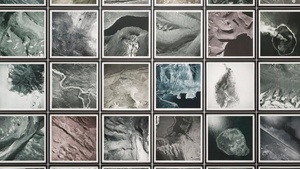
Cartographic plans are rarely unambiguous records of the given. Even if they suggest rationality and objectivity, they move in a space never free of subjectivity between images and signs, between image and language - ultimately between reality and fiction - also because they follow standards that determine where accuracy ends in detail. The location of KAI 10 | ARTHENA FOUNDATION will hardly be found on printed maps of the world. Only digital maps allow you to zoom in at will. However, there are countries and places that can only be found on fictional maps, such as Lummerland from Michael Ende's famous Jim Knopf novels. However, cartographically inspired fictions are not only found in children's books, but also in the work of many artists. Here we find original depictions and illustrations of travel experiences, as well as detailed sketches of imaginary places and countries. Cartographic, symbolic or ornamental structures can develop into very individual world designs. Much of what can be seen in Uncertain Maps remains ambiguous: is it a depiction or evocation of an external reality, of landscapes and cities? Are they attempts to record inner, mental states - emotional or cognitive maps that represent spatial information in memory? Or are digital data streams made visible? Even images created for practical and scientific purposes can be 'read' differently than for the intended cartographic project, such as satellite images from the Icelandic National Land Survey. When artists explore a terrain, be it real or imaginary, their mappings usually become Uncertain Maps that lead us to paths that cannot be found in any ordinary atlas.
Group exhibition: Franz Ackermann, Jens Bleckmann, DAG, Olafur ElIasson, Esther Ernst, Julius Hartauer, Michael Golz, Christian Pilz, Isabell Schulte
Curators: Ludwig Seyfarth & Klaus-Peter Kirchner
Location






Events near you
Activities near you
Popular event locations
The best event recommendations for the Rausgegangen App!
