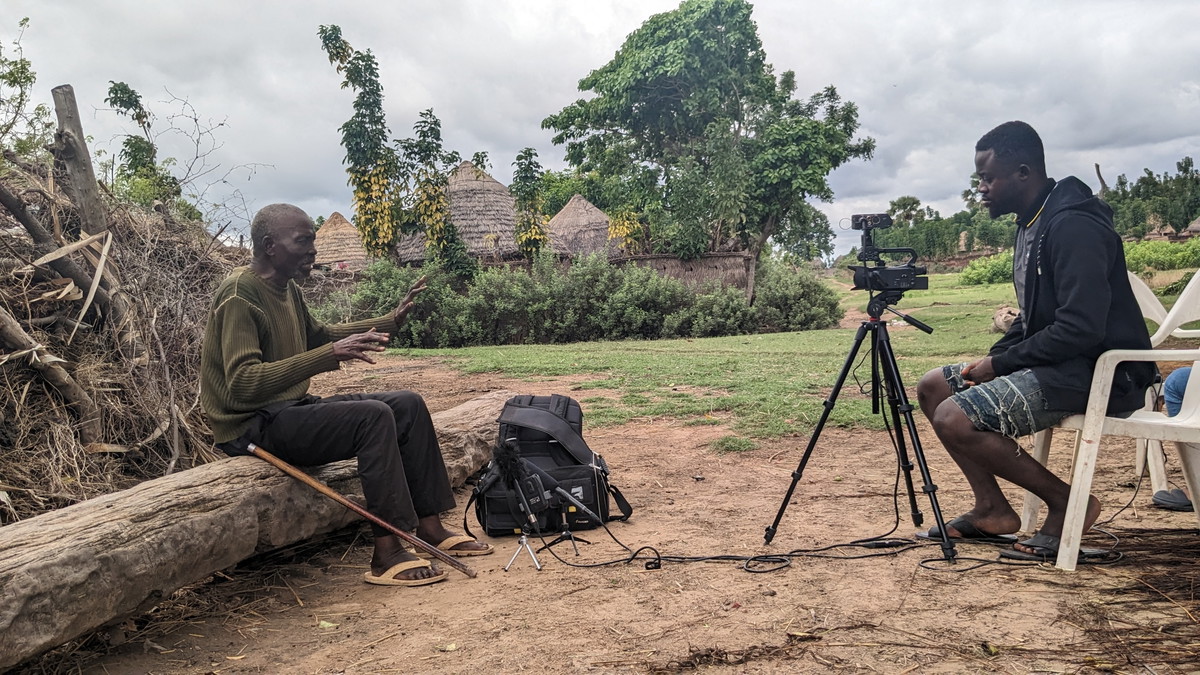
PHOTO: © Nlabephee Kefas Othaniel (rechts) und Pa Kanawa Musa (links) während einer Recording Session in Kwangkah village of Dza. © Hammanson Sule
Verwandt sein: geteilte Sprache, geteiltes Wissen?
In the organizer's words:
The family is often regarded as the smallest but most important building block of society—all over the world. Family and kinship shape social relationships and a sense of belonging through birth, marriage, or adoption. They define social roles and expectations. People help one another and work together. They take responsibility for one another and share their resources. Kinship ties influence how larger groups form, how property and traditions are passed down, and how tasks and duties are distributed.
It is within the family that children first learn to communicate, to speak, and to understand the norms and values that shape daily life. Within the family, language and ways of life are passed down from one generation to the next—whether through stories, celebrations, admonitions and rules, or simple everyday habits. In this way, the family keeps language and culture alive.
Government measures and political pressure—such as forced assimilation or discriminatory laws—restrict family members’ ability to pass on their language and cultural heritage. Migration and displacement weaken the bonds within and between families and communities and hinder the intergenerational transmission of language and knowledge. Globalization exacerbates these dynamics. As dominant world languages become increasingly prevalent in education, the workplace, and the media, local and minority languages often lose their prominence. Together, these developments threaten cultural identity. For many communities, it is difficult to preserve their languages and cultures in an increasingly globalized world.
In the films featured in the exhibition, you will meet people from Indigenous communities who are documenting their language and culture before it is too late. In collaboration with the Endangered Languages Documentation Programme and the Endangered Languages Archive, they are archiving their material and using it to create picture books as well as learning and teaching materials for their communities. For this exhibition, they have shared their perspectives on the role of the family and the importance of kinship ties. They describe their way of life and the changes they are currently experiencing in their communities.
In the photo, Nlabephee Kefas Othaniel is photographing his uncle, Pa Kanawa Musa. He is documenting Dza, the language of his community in Nigeria, a country with 600 languages. Fewer and fewer young people are learning and speaking Dza or are familiar with the traditional ways of life of the older generation. Nlabephee is the oldest and only one of six siblings who still speaks Dza, albeit only partially. His siblings speak mainly Hausa and some English.
A temporary exhibition by the Humboldt Forum Foundation (SHF) at the Berlin Palace and the Ethnological Museum of the State Museums of Berlin – Prussian Cultural Heritage Foundation, in collaboration with the Endangered Languages Archive & Endangered Languages Documentation Program of the Berlin-Brandenburg Academy of Sciences and Humanities.
The exhibition was curated by Ute Schüren, Curator of American Archaeology, Mesoamerican Collection, Ethnological Museum, State Museums of Berlin, Prussian Cultural Heritage Foundation, and Mandana Seyfeddinipur, Director of the Endangered Languages Archive & Endangered Languages Documentation Program, Berlin-Brandenburg Academy of Sciences and Humanities.
- Regular admission: 14 EUR; starting July 13, 2026: 9 EUR; an exhibition ticket for the Ethnological Collections and Asian Art is required
- 2nd floor, Room 203
- Hours: Mon, Wed, Thu, Fri, Sat, Sun: 10:30 a.m.–6:30 p.m.; Tue: closed
Location
Weitere Termine von Verwandt sein: geteilte Sprache, geteiltes Wissen?
13.
Juli
10:30
Berlin
Humboldt Forum
9,00 €
15.
Juli
10:30
Berlin
Humboldt Forum
9,00 €
16.
Juli
10:30
Berlin
Humboldt Forum
9,00 €
You might enjoy this as well?



Noch mehr Events dieser Location-Page