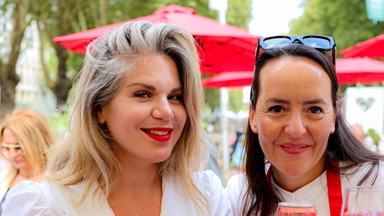
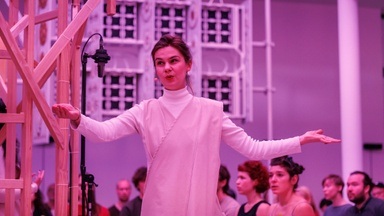
PHOTO: © Janina Lamberty
DFD Festival 2026: Janina Lamberty
In the organizer's words:
Biography
Janina Lamberty (born 1961 in Ratibor, Poland) is a conceptual artist, sculptor, graphic artist, and designer. In 1971, she moved with her family to Leverkusen, where she discovered her passion for nature at an early age. From 1976 to 1978, she took art lessons from Peter Lorenz. She later completed an apprenticeship in surveying, which influenced her subsequent artistic work. After years of working in her profession, she devoted herself intensively to art and studied under Ernst Otto Köpke from 1989 to 1997; his works, characterized by mosaics and architecture, greatly inspired her. Since the 1990s, she has lived and worked in Düsseldorf and Barcelona.
Work
Lambert’s work is strongly influenced by scientific and nature-related themes, particularly due to her earlier career in surveying. Her art explores the interplay between nature, chance, and artistic control. A central theme in her work is the transience of the moment, often linked to meditative and ritualistic moments.
Two of her best-known series are *Cascadas* (Waterfalls) and *Cañas* (Reed Sticks):
- Cascadas: In this series, Lamberty interprets the phenomenon of the waterfall. She uses high-quality paper that, through bends and rhythmic undulations, evokes the structure of falling water. In doing so, she applies shades of color that suggest the movement and acceleration of the water. The vertical paper panels, with their wider and narrower bands of color, create a dynamic that mimics the fall of water. Landscape elements, such as terraced fields, also find their way into this series. Her work is not only an artistic but also an aesthetic translation of natural phenomena into a visual language.
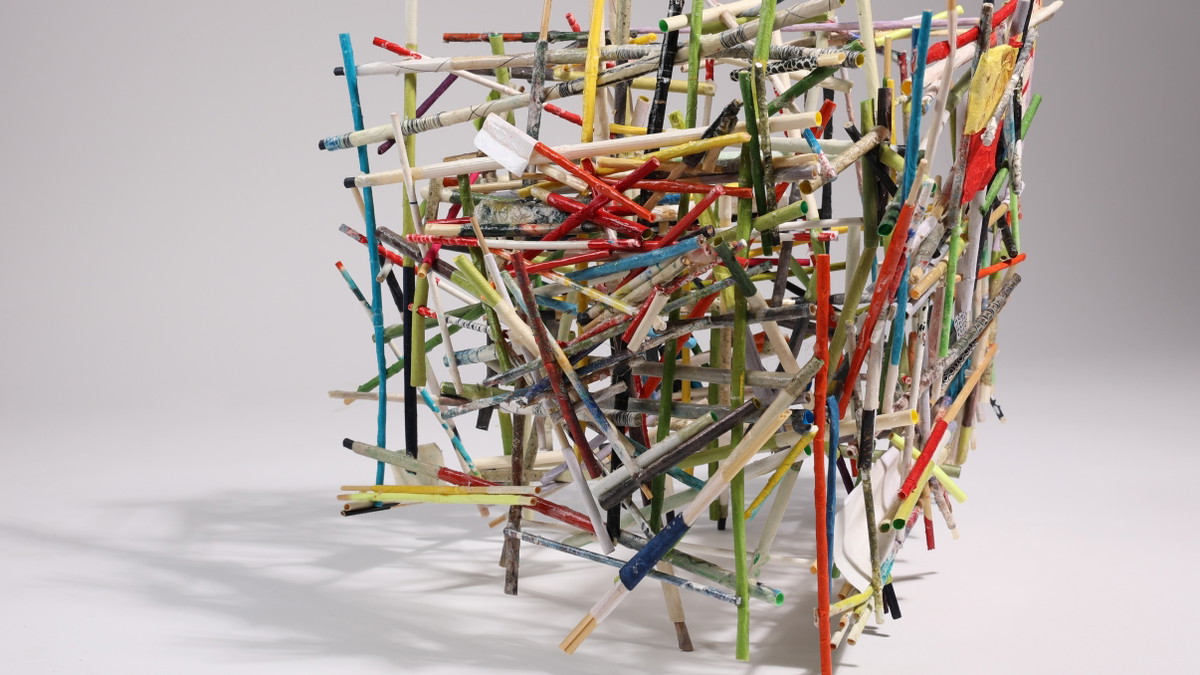
- Cañas: In this series, Lamberty uses straw sticks, which she drops randomly according to the Mikado principle and then fixes in their resulting positions. These works evoke natural phenomena such as eddies or whirlpools. Chance plays a central role: the apparent chaos is aesthetically ordered, while colors and forms—determined before the straw is dropped—influence the final result. This method lends the works a meditative, ritualistic character, similar to Zen practice or the Japanese tea ceremony. Despite the random composition, the design is highly focused and technically precise, which lends the works a special artistic depth.
Lamberty often uses Japanese papers and makes her own papers from plant fibers. These materials, which she frequently brings back from her travels, carry local significance and add another cultural dimension to her works.
Her works can be understood as aesthetic transformations of observations of nature and topographical studies stemming from her scientific background in geodesy. Statements about differences in elevation and depth in landscapes are visually conveyed in her artworks. A quote from Jürgen Raap aptly summarizes this approach: “Janina Lamberty translates the methods used in geodesy to define reference systems [...] into art.”
Design
In addition to her independent artistic practice, Lamberty also works in applied design. She has carried out projects for renowned companies such as Villeroy & Boch, including the design of a mocha cup. Her design work is characterized by a holistic approach that combines art, science, and craftsmanship. Among other things, she has drawn inspiration from Catalan architecture—particularly the work of Antoni Gaudí—as well as from Goethe’s theory of colors. These influences are reflected in her designs, which are realized in porcelain, stainless steel, and paper.
One notable design project is the 3D Mikado game “Balance,” which she developed for the company Emform. In addition, she created personalized design items for Bayreuth Marketing & Tourismus GmbH to mark the 200th anniversary of Richard Wagner’s birth.
Her designs often reveal a strong connection between art and sociology. For example, the “Joy” design reflects the sociological characterization of “Generation Y,” which strives for a balance between work and leisure. In her stationery designs, such as the “Rose” design, she draws on cultural symbols, anchoring them, for instance, in the Catalan tradition of Sant Jordi, during which roses and books are given as gifts.
Location

Organizer | Festival
You might enjoy this as well?











Noch mehr Events dieser Location-Page