

PHOTO: © FOTO: © Hannes Kocholl via Unsplash
RAW Berlin Site in Jeopardy
RAW in Danger: What Will Remain If Berlin’s Cultural Infrastructure Continues to Be Displaced?
In June, Cassiopeia and other venues on the RAW grounds faced eviction. The response: protests, political resolutions, and new rounds of talks. What sounds like yet another “clubs dying out” headline is actually an urban policy showdown over contracts, timeframes, and the question of how much subculture Berlin is willing to support in the future.
The dispute comes at a time when cultural venues are already facing pressure from multiple fronts: rising costs, a shortage of space, stricter regulations, and a broader political climate in which culture is repeatedly treated as a negotiable item in the budget. Following massive cuts to the 2025 culture budget, rbb24 reports that significant savings are again expected for the 2026/27 biennial budget (compared to 2025: 110 million euros in each year). In this complex situation, the “demise of clubs” is less a single event than a symptom: when venues become more expensive and budgets shrink, the state of emergency quickly becomes the new normal. And cultural policy becomes a matter of endurance rather than shaping the future.
The RAW complex is one of those Berlin spots that have become an integral part of the city’s landscape: old industrial sites, graffiti, a flea market, a beer garden, art studios, sports—and, in between, clubs that continue to translate the city’s post-1990 promise into their programming to this day. That is precisely why the current conflict is so charged. In mid-June 2026, the property owners declared the “RAW West” zoning plan process a failure; eviction notices began circulating, and suddenly it was no longer just a plan under debate, but the very existence of structures that had grown over the years. The negotiations turned into a deadline, and the deadline turned into a political event: demonstrations, calls for solidarity, and new meeting dates.
Precisely because the RAW is more than just a single club, the conflict has become a proxy debate. Two Berlin narratives collide here. One promotes the city internationally as a place of freedom, experimentation, and nightlife. The other increasingly organizes urban development through a logic of commercialization, legal frameworks, and risk minimization, thereby pushing to the margins precisely those “unplanned” milieus that made Berlin attractive in the first place. From this perspective, the RAW is not merely a subculture but cultural infrastructure: a place that enables work, creates public space, attracts emerging talent, and holds the neighborhood together.
From Bureaucratic Red Tape to Eviction: Why RAW 2026 Will Be a Matter of Life and Death
In 2026, the RAW site will serve as a test case to determine whether Berlin merely tolerates open spaces or truly safeguards them. On June 15, 2026, the dispute over “RAW West” reaches the next stage of escalation: The Kurth Group will declare the zoning plan process a failure, and the bureaucratic red tape will give way to concrete eviction notices. The situation is particularly precarious for Cassiopeia, which is portrayed in media coverage not as “just one club among many,” but as an economic anchor: If it closes, there is a risk of a domino effect for projects in the “Socio-Cultural L” (SKL), which, according to the operators and the media, are also linked to the club through cross-subsidization.
However, the conflict has a history that shows just how long tensions have been running high here. As early as late January/February 2026, several businesses came under pressure: According to rbb24, clubs and restaurants were issued a ban on use by the owner, citing “fire safety and permitting issues”; Operators dispute this and point to existing documentation, while district politicians interpret the move as a means of exerting pressure. In the background lies the fundamental urban planning dilemma: The western part of the site (the former Reichsbahn repair yard between Revaler Straße, Warschauer Straße, Modersohnstraße, and the Stadtbahn) is slated for development through the “2-25a” zoning plan process, which has been underway since 2019—raising the question of whether and how residential construction can proceed without displacing cultural activities due to noise control measures or pressure to vacate.
According to several media reports, an offer was on the table in mid-May 2026 that initially seemed like a potential compromise: a draft framework agreement intended to secure the SKL’s future through a 30-year master lease, supplemented by investment grants and a noise assessment financed or commissioned by the State of Berlin. The fact that the situation nevertheless escalated follows a pattern that has repeatedly emerged in Berlin. Places that have emerged from vacancy, improvisation, and organic development come under pressure—at the latest—when they are to be transitioned into a phase of legal, planning, and economic “normalization.”
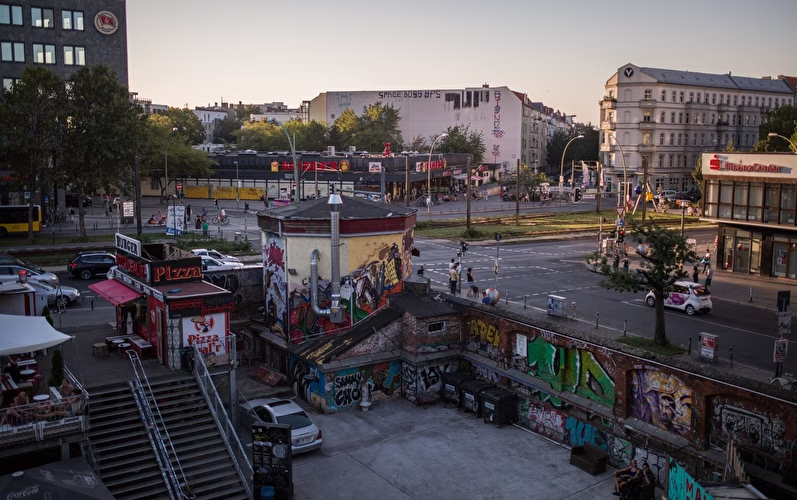
From our perspective, this friction is not an isolated incident, but systemic. When cultural venues depend on private ownership, short-term contracts, and politically uncertain funding frameworks, “security” is never just a matter of goodwill, but of power. The RAW conflict thus illustrates how vulnerable Berlin’s cultural scene is when the city, while thriving on its reputation for creative freedom, fails to treat its basic cultural services as infrastructure—with long-term guarantees, adequate budgets, and a realistic land-use policy.
When the tide turns in mid-June, the scene responds in its own way: not only with statements, but also by taking to the streets. On June 19, 2026, according to the Tagesspiegel and police reports, around 1,000 people demonstrate under the slogan “RAW for Everyone—Preserve Club Culture, Protect Free Spaces” against the impending closure of Cassiopeia and other venues. At the same time, an originally planned birthday rave (Weißer Hase) turns into a protest event. For the property owners, the issue is “development” and building regulations; for the district and the operators, it is about binding commitments, particularly the duration of the safeguards (described in the reports as a conflict between 30 years versus significantly shorter guarantees).
By the end of June, there was at least a sign that the escalation didn’t have to be the final word. rbb24 reported on June 26 that an initial meeting had already taken place and that another meeting was scheduled for July 6, 2026. However, this is not a solution, but rather a brief respite in the pace of evictions. But that is precisely the cultural crux of this conflict. At the RAW site, Berlin is not just negotiating over a piece of land, but over the question of whether the city will exploit its famous open spaces for image-building or treat them as relevant infrastructure with a secure future.
What is our scope of action?
What stands out in the RAW conflict is that solidarity here is a lived practice and a shared consensus. It can be organized. Platforms like ours, or other cultural and event media, can use their reach to exert concrete influence without presuming to lead the negotiations. By raising the profile of solidarity events, publicizing demonstrations and informational sessions, curating background information, and thereby maintaining steady public attention rather than letting it flare up only at the moment of escalation. The fact that Cassiopeia is already present as a venue on such platforms shows just how closely the cultural economy and visibility have long been intertwined. Making programs discoverable helps ensure that revenue flows and that venues don’t get lost in the noise.
We can all get involved in several ways: by attending events (protests, rallies, BVV meetings, solidarity events), spend money where it makes a difference (tickets, donation campaigns—provided they’re officially verified), and share the workload (translations, documentation, design, communication, and expert assistance with applications and legal/planning issues).
When cultural venues come under pressure, it’s not just a contract that matters, but also how many people make it clear that this venue is needed as part of the infrastructure.
In a nutshell
- Auf dem RAW-Gelände drohte im Juni 2026 mehreren Orten die Räumung, besonders dem Club Cassiopeia
- Das ist wichtig, weil am RAW nicht nur ein Club hängt, sondern viele Projekte, Angebote und kulturelle Infrastruktur
- Gleichzeitig steht Berlins Kultur insgesamt unter Druck: Räume werden teurer und die Politik plant Einsparungen im Kulturbereich
- Deshalb ist der RAW-Streit ein Beispiel dafür, wie Berlin mit seinen kulturellen Freiräumen umgeht: schützen – oder verdrängen